Learn

AI visibility is whether the answer says your name.

When a buyer asks an assistant who to call, where to eat, or which practice to trust, the reply is a short answer with names in it. AI visibility is whether one of those names is yours. It is not a ranking, not traffic, and not a number your current dashboard shows, which is exactly why the businesses losing it rarely know.

Last reviewed 2026-07-28
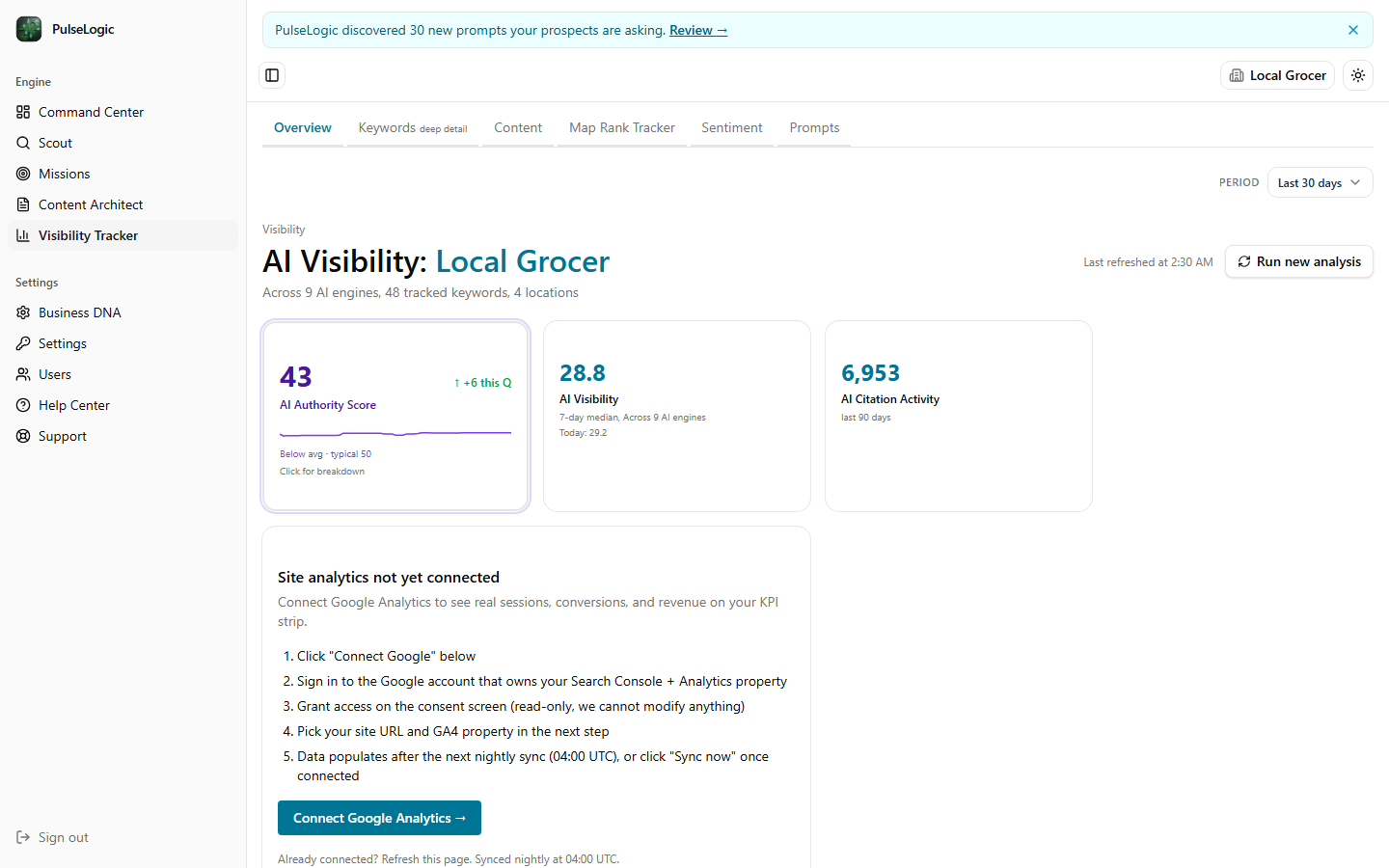
A visibility overview showing a composite score across nine engines, a seven day median, citation activity, and per-location coverage.
The visibility overview: one score per surface, per location. Product screenshot from a pilot account, anonymized.

The loss that leaves no trace

Every other channel tells you when it fails. A ranking slips and the chart shows it. Cost per lead climbs and the invoice shows it. Traffic falls and analytics shows it. This one is different: the customer asked an assistant, got two or three names that were not yours, and called one of them. There is no impression to count, no click that did not happen, no line anywhere in your reporting. You experience it as a quiet week and explain it as the season.

The list got shorter

A page of results had ten slots and a second page behind it. An answer names two or three businesses and stops. That is the whole change, and it is a brutal one for anyone who was comfortable at position six. There is no scrolling to rescue you and no second page to be on. Either the answer includes you or the buyer never learns you exist.

Who is actually asking

The habit is not universal yet, and pretending otherwise would be the wrong argument. BrightLocal's Local Consumer Review Survey 2026, a poll of 1,002 US adults, found 45 percent had used AI tools for local business recommendations in the prior year, rising to 64 percent among ages 30 to 44. The second number is the one worth sitting with, because in most local categories the person in that age band is the one doing the research, whether for themselves or for a parent.

Per location, not per brand

Most tools that measure anything here measure a brand or a domain. A local business does not experience the world that way. You are visible in one town and absent in the next, and an average across both hides the one that needs the work. Measurement that is worth acting on reports each market separately, because the fix is always local: a page, about that question, in that place.

Measuring where you stand

Ask the question yourself first. Open any assistant, ask what a customer in your area would ask, and read the names. That costs nothing and it is usually enough to end the debate about whether this matters for you. What it does not give you is coverage across every surface, or a record over time, or the question-by-question detail of where you are losing, which is where a tool starts earning its money.

What this page did not cover

Naming the edges is part of the answer. Anything below is a different question with a different page.

  • How to fix a gap once you find one. That is the writing half, and it has its own pages.
  • Traditional local SEO. Your Google Business Profile still matters and still feeds the Local Pack.
  • Enterprise or national brand tracking. This page is about businesses with addresses.

Ask an assistant what a customer in your town would ask about your category, and read the names it gives back. The free AI Mirror Test runs that question across all nine surfaces we track today and prints every question it asked, so nothing in the result has to be taken on trust.

Run the free AI Mirror Test

Questions

What buyers ask before they start

Is this different from local SEO?

It overlaps and it is not the same. Local SEO largely optimizes for a map result and a list of links. This is about whether a written answer names you, which draws on more than your profile and can leave you invisible even while your map ranking looks healthy.

Can I just check this myself?

Yes, and you should, today. Ask an assistant the question your customers ask. What you cannot do by hand is check every surface repeatedly, keep the history, and see which specific questions you lose, which is the part that tells you what to do next.

Does being absent from AI answers actually cost anything yet?

That depends on your category and your customers, and anyone who answers it confidently without looking at your market is guessing. The honest version is that the cost is small and growing, the fixes take months to land, and the businesses being named in these answers now are the ones that wrote the pages last year.