AI visibility for senior living
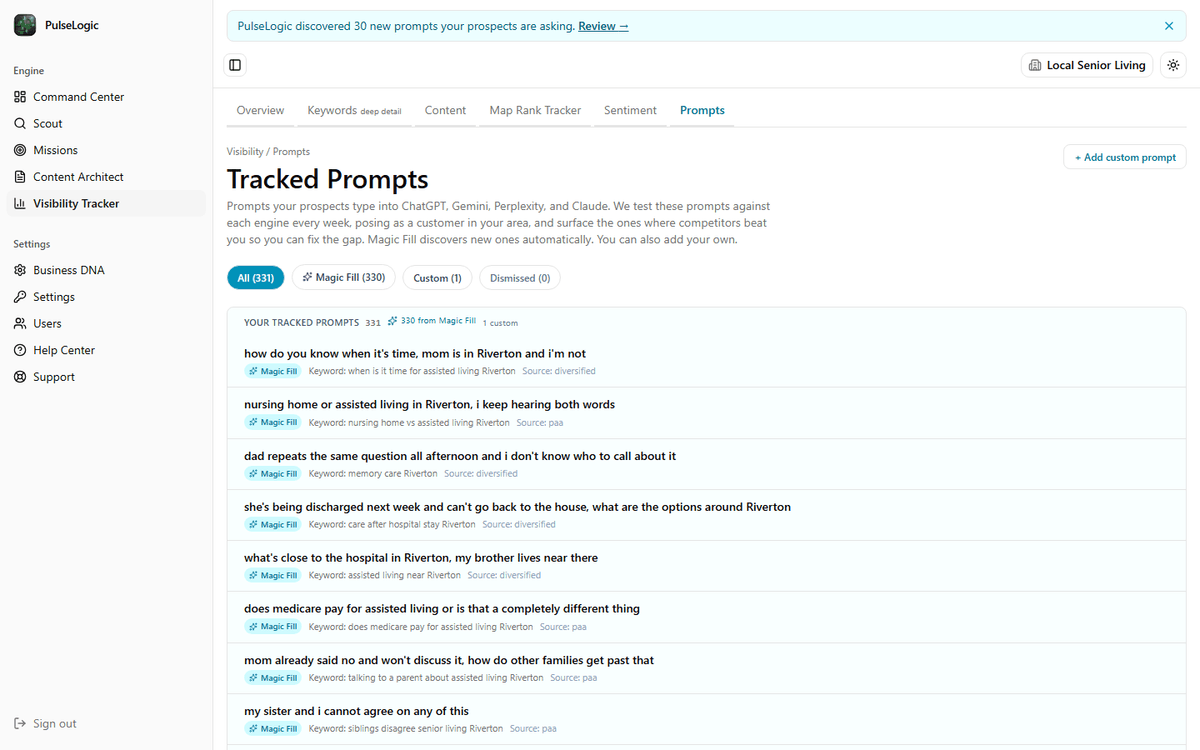
Families ask AI whether it is time for assisted living. Then they ask which one.
The person comparing communities is almost never the resident. It is a daughter or a son, researching at night, often months before anyone moves. No group has picked up the habit of asking an assistant faster: BrightLocal's Local Consumer Review Survey 2026, a poll of 1,002 US adults, found 45 percent had used AI tools for local business recommendations in the prior year, rising to 64 percent among ages 30 to 44. PulseLogic measures whether the answer names your community across the nine surfaces we track today, and how it describes you next to the others.
Buyer asks
Answer names
The AI engine compares local options, checks the evidence it can cite, and names your business when your content gives it the clearest answer.
Why this market needs answer visibility
The search starts as a worry, not a shortlist. By the time a family calls, the assistant has already narrowed the field for them.
The decision is made months before the tour
By the time a family fills in a form, they have been reading for weeks. The questions start vague and get specific: whether mom is safe alone, what memory care actually means, what it costs, which places take a resident who wanders. Each of those is a question an assistant answers with names, long before anybody picks up a phone. If you are not in those answers, you are not in the shortlist that produced the tour.
How you are described matters as much as whether you appear
Being named is the first half. The second is what the answer says about you next to the community two towns over. Trust categories live and die on that comparison, and it is the part operators almost never see, because nobody forwards you the answer that sent a family somewhere else. You see it here, on the same measures, from the same answers. And when a page is needed to change it, families can tell the difference between one written by a marketer and one written by somebody who has walked the halls at 6pm. Your staff already know what that difference is. The fastest version of this is the one where they talk and the draft carries what they said.
What you open to
The morning after you turn it on.
What it does not do
Worth knowing before you buy, not after.
- It does not manage inquiries, tours, or your CRM.
- It does not write clinical or medical claims, and it should not. Occupancy questions and care questions are different pages with different reviewers.
- It does not guarantee an AI engine will name your community. It measures, prioritizes, drafts, and measures again.
Ask an assistant where a family in your county should look for memory care. Read the names it gives back, and read how it describes them. The free AI Mirror Test runs that question across all nine surfaces we track today and prints every question it asked.
Run the free AI Mirror TestQuestions
What buyers ask before they start
Our inquiries come from referral agencies. Does this compete with them?
No, and it is worth separating the two. Referral agencies charge for a placement. This measures the families finding you directly, which is the channel with no per-move fee attached. Most operators do not know how large that channel already is.
We serve a small area. Is there enough search for this to matter?
The volume is low and the value per resident is high, which is the opposite of most local categories. A handful of questions decide a large share of your move-ins, so the list of things to fix is short and worth finishing.
Who reviews what gets published?
You do. Every page starts as an outline you can rewrite before anything is drafted, and the publish gate refuses a page while structured data is invalid or a serious issue is unresolved.