AI visibility for multi-location retail
Store seven is invisible and the company average looks fine.
This is the failure a brand-level number is built to hide. Aggregate your locations into one score and a strong flagship carries three weak neighbourhoods, so the report looks healthy while a third of your footprint is missing from the answers buyers actually get. Each location is measured on its own here, which is the only way the weak one becomes a name on a list instead of a suspicion.
Buyer asks
Answer names
The AI engine compares local options, checks the evidence it can cite, and names your business when your content gives it the clearest answer.
Why this market needs answer visibility
A customer asks about the store nearest them, never about your brand in aggregate. The answer they get is local whether your reporting is or not.
One company score, and it looks fine.
Nine store scores, and two of them are not.
The average is the most comfortable number in the building and the least useful. It is a weighted opinion of your best market, and it will not tell you which manager has been quietly right about their neighbourhood for a year.
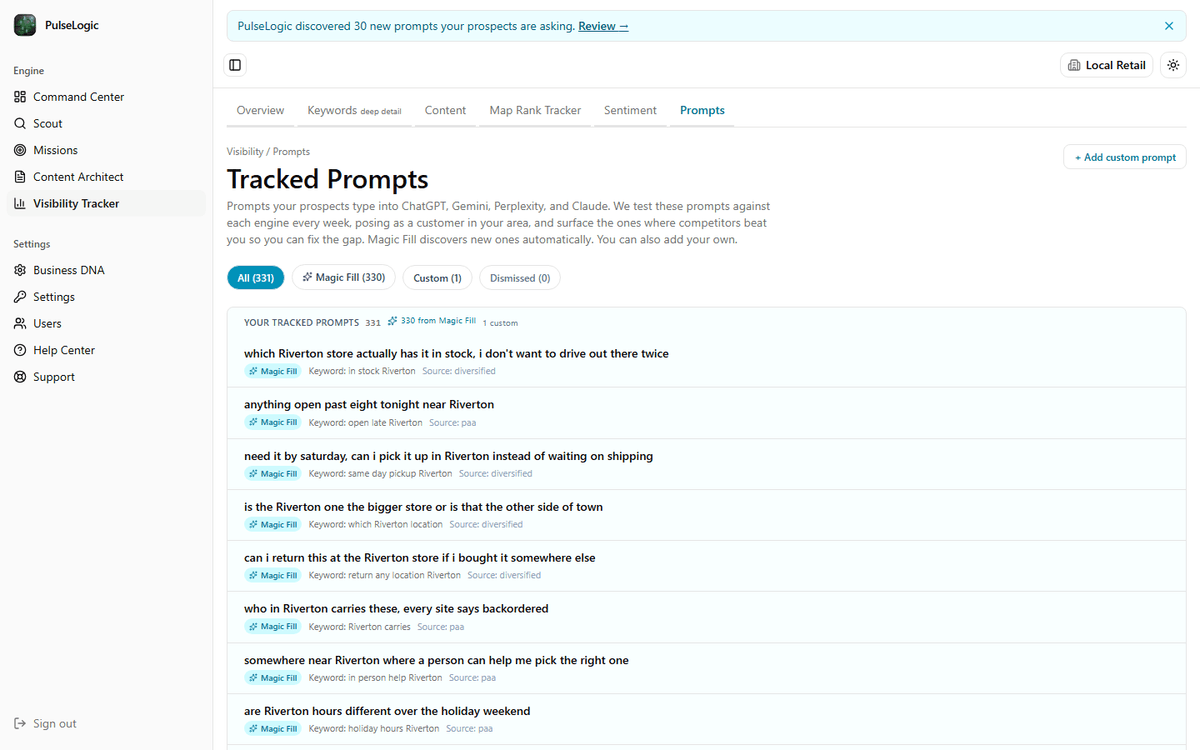
Every store is a different answer
An assistant answering a question in one suburb is drawing on different local material than the same question two towns over: different competitors, different coverage, different pages written by different people. The result is that your footprint is not one visibility problem. It is a set of them, most of them fine and a couple genuinely bad, and the aggregate hides exactly the ones worth an afternoon.
The fix is local too
Because the gap is per market, so is the page that closes it. Not a brand campaign. A page about that question, in that place, mentioning the things that are true about that store. That is the work, it is finite, and it is assignable to whoever owns the market.
One engine across every store
PulseLogic is 249 dollars a month for the first store, and each additional store is 49 dollars a month. Every store is scored separately, so a chain sees each market on its own instead of one blended number.
What you open to
The morning after you turn it on.
What it does not do
Worth knowing before you buy, not after.
- It does not manage store listings, hours, or reviews across locations.
- It does not replace merchandising or local advertising.
- It does not guarantee an AI engine will name any given store. It measures, prioritizes, drafts, and measures again.
Pick the location you worry about least and ask an assistant the question its customers would ask. Then pick the one you worry about most. The free AI Mirror Test runs that comparison across all nine surfaces we track today and prints every question.
Run the free AI Mirror TestQuestions
What buyers ask before they start
We already track rankings per store. Is this the same thing?
No. Ranking tells you where a link sits in a list. This measures whether a written answer names the store at all, which can be false while your map ranking looks perfectly healthy.
Who does the work once a gap is found?
Whoever owns the market, and the assignment is scoped for them: one question, one page, with the research attached. It is deliberately small enough to be delegated.
Does the price scale with locations?
Gently. PulseLogic is 249 dollars a month for the first location, and each additional location is 49 dollars a month. There is no per-user charge, and every location is scored separately.