AI visibility for dentists
Patients ask AI for a dentist who takes their insurance. What does the answer say?
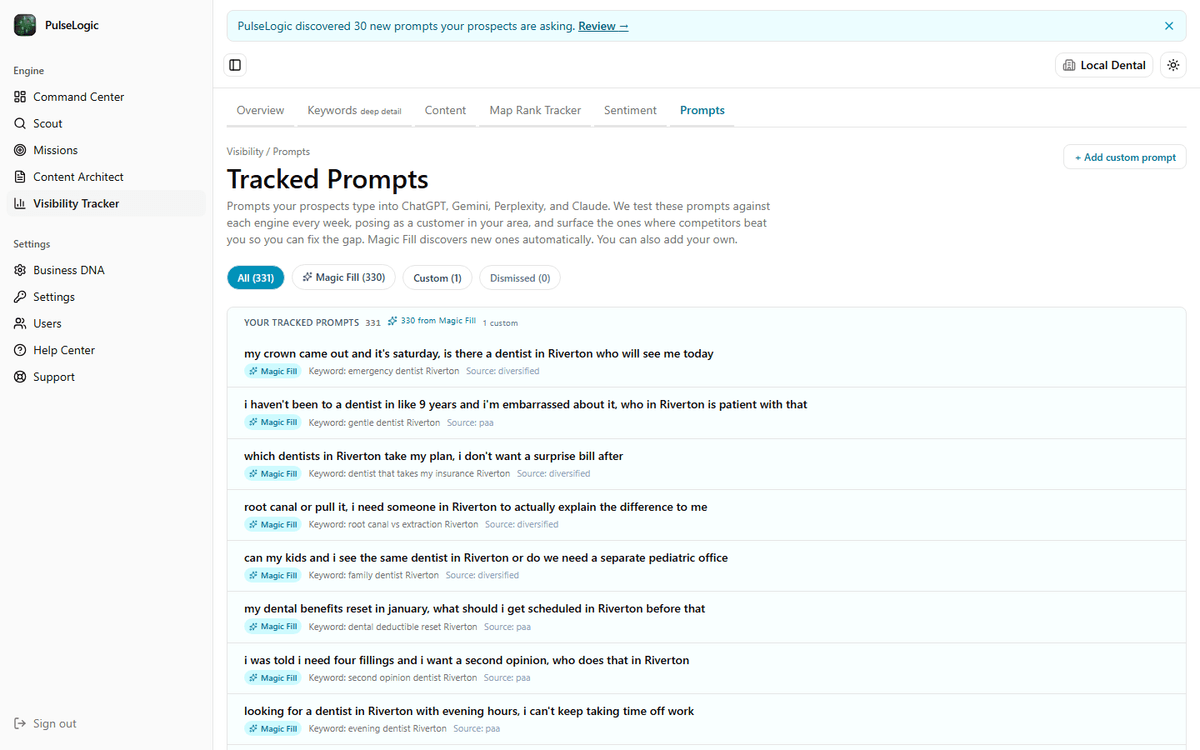
That answer either has your practice in it or it does not, and there is no second page to be on. Patients do not ask assistants for keywords. They ask for a dentist near them who accepts their plan, sees kids and parents in the same visit, and is patient with anxious people. The assistant filters on every one of those constraints and answers with names. PulseLogic tests the questions your patients actually ask against the nine surfaces we track today, and turns each loss into a page your practice approves before it publishes.
Buyer asks
Answer names
The AI engine compares local options, checks the evidence it can cite, and names your business when your content gives it the clearest answer.
Why this market needs answer visibility
A patient who was steered elsewhere never fills out your form, so the loss is invisible from inside the practice.
The constraints are the whole question
Insurance, hours, whether you see children, how you handle someone who has avoided a chair for nine years. Patients name those constraints out loud when they ask an assistant, and the assistant answers on them. A practice that has written those answers down gets named. A practice that has not is filtered out before anyone compares clinical quality, which is the part you have actually spent your career on.
You will notice this on an intake form first
The first time a new patient writes an assistant's name where a referral or a search used to go, you will know the shift reached your zip code. Whether that is already a trickle or a stream is precisely the thing you cannot see from inside the practice, because the patient who was steered elsewhere never filled out your form at all.
It is already written before you sit down
You do not start from nothing. Each gap becomes a ranked assignment, the draft arrives grounded in your practice's own information, and a polished piece takes roughly five minutes of your attention to sound like you. The reason that post is not published is not that it is unwritten. Nobody ever told you it was finished. Here the publish gate does: structured data valid, open issues resolved, then it ships to your site.
What you open to
The morning after you turn it on.
What it does not do
Worth knowing before you buy, not after.
- It does not write clinical claims, and you should not want it to. Treatment content needs a clinician's review and the gate will not supply one.
- It does not manage scheduling, recall, or patient communication.
- It does not guarantee an AI engine will name your practice. It measures, prioritizes, drafts, and measures again.
Ask an assistant for a dentist in your town who takes a common plan and is good with nervous patients. Read the names. The free AI Mirror Test runs those questions across all nine surfaces we track today and prints every one it asked.
Run the free AI Mirror TestQuestions
What buyers ask before they start
We get most new patients by referral. Does this matter?
Referrals are the strongest channel you have and this does not touch them. It measures the patients who are choosing without one, which is the group most likely to be asking an assistant, and the group you currently have no visibility into at all.
Is publishing AI-assisted pages risky for a medical practice?
The content is AI assisted and we say so plainly. What protects you is review, not concealment: you approve the outline before anything is drafted, you approve the page before it publishes, and clinical claims belong to a clinician either way.
Do we need a second subscription for a second office?
PulseLogic is 249 dollars a month for one address, and each additional office is 49 dollars a month. Every office is scored separately.