Feature
The writing was never the slow part.
There are four jobs in publishing an article and only one of them is writing. Deciding what is worth the afternoon. Gathering what people actually ask and what the facts are. Writing it. Then knowing it is finished well enough to ship. Most people who have stopped publishing did not stop because they cannot write. They stopped somewhere in the other three.
The assignment arrives decided, with the reason attached
An outline you argue with, before a word is written
Grounded in what the business already knows, not a blank prompt box
A publish gate that tells you it is finished
Nobody is short of writing tools
You can open a free chatbot right now and have a competent article in thirty seconds. So if a faster writer were the answer, this problem would already be solved and your site would not have the same four posts on it from last spring. The reason it is not solved is that producing the words was never the bottleneck.
Deciding is the job that actually stalls
Most weeks the honest reason nothing got published is that nobody knew which thing was worth the afternoon, so the afternoon went to something with a deadline attached. Here the assignment arrives already decided, ranked, with the buyer question that produced it attached, so the choosing is done before you sit down. You are not out of ideas. Nobody ever handed you the list, in order, with a reason on each one.
It does not hand you a blank page, and it does not hand you a finished argument
A blank document is paralysing, and a finished draft is worse, because now you are arguing with somebody else's structure instead of writing your own. So the first artifact is an outline: numbered sections you can reorder, cut, or redirect. Reacting to eight headings takes five minutes. Producing eight headings is the part that takes a Tuesday. The writer then builds on the structure you approved rather than presenting you with a fait accompli.
The research arrived with the assignment
The questions real buyers ask about this topic, and the facts already known about your business, are attached to the assignment before you open it. That is the step that quietly eats afternoons: not the writing, the twenty minutes of looking things up that turns into ninety. It is not a step you have to find time for. It arrived with the assignment.
It was given your voice, not taught it
Your industry, your categories, your locations, your differentiators, the words you use and the words you have banned: all of it is recorded, and you can open the file and see who told it what. That is the difference worth caring about. A tool that claims to have learned your voice is asking you to trust something you cannot inspect. This one is auditable, and every extracted field carries the evidence it came from, so a claim with no support behind it is downgraded rather than quietly applied.
Quotes from people who actually said it
Ask any general assistant to write a quote from your service manager and it will write a good one. He never said it. Here, named people at the business have their actual words captured with provenance, and a quote that drifts from what the person said turns the publish button off. That is a mechanism rather than a promise, which is the only version of this claim worth making.
Bring the draft that never shipped
The half-finished document in your drafts folder is a supported input, not a workaround. Typed notes, pasted text, a Word file, a PDF: it becomes the shape you described, with the gaps filled. The reason that post is not published is not that it is unwritten. Nobody ever told you it was finished.
It is a real editor, not a text box
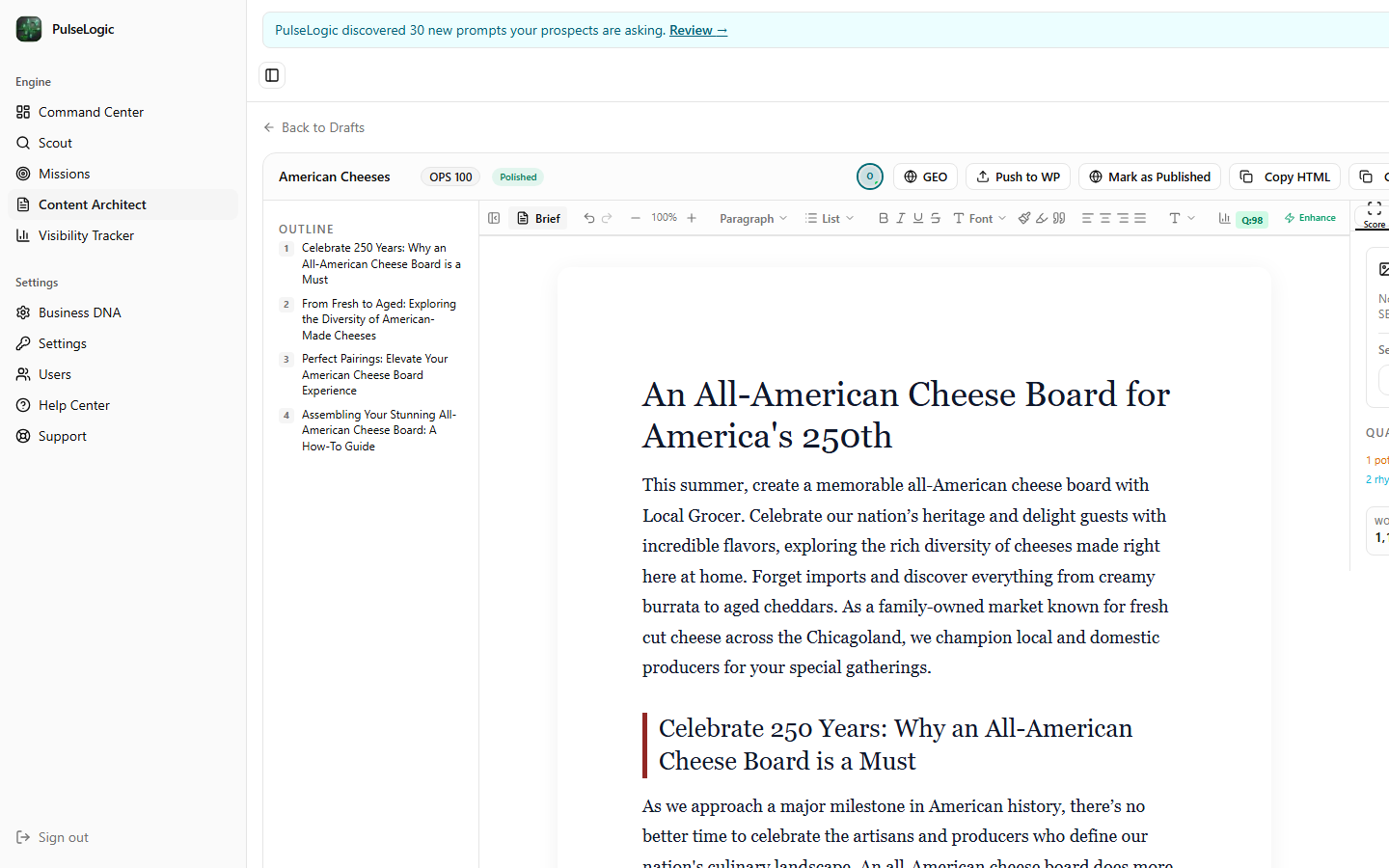
The draft arrives in a proper writing surface, because the moment after generation is when most of the work happens. Headings, bold and italic, underline, bulleted and numbered lists, quotes, code blocks, links, images, tables, checklists, text alignment and full undo history are all there under your hands. The point is that you never have to move the piece into another application to finish it, which is where drafts go to die.
Knowing it is done
The last job is the one nobody talks about. A draft sits for three weeks because there is no moment that says ship it. Here there is: the checks run, the issues are listed with a control that jumps you to each one, and the publish is refused while structured data is invalid or something serious is unresolved. When it clears, that is the signal. Then it goes to WordPress as a draft, or you take clean HTML somewhere else.
How it works
01
Take the assignment, or bring your own
Start from something the product surfaced, type a topic and let a short research pass run, or upload the draft that stalled.
02
Set who is speaking
Content type, length, and whose expertise is behind it, decided before the outline is built rather than corrected afterwards.
03
Argue with the outline
Reorder, cut, or redirect any section. This is the cheapest place to change your mind and the step most tools skip entirely.
04
Generate, check, publish
The writer builds on your approved structure, the checks run, and the gate verifies structured data before either exit: WordPress draft, or clean HTML.
What it does not do
Worth knowing before you buy, not after.
- It is AI assisted and we say so. The position is editorial control, your voice, and the gates that block a bad publish, not a claim that a person typed every word.
- It does not promise a finished article in ninety seconds. Ninety seconds is the outline. A polished piece takes roughly five minutes of your attention.
- The quote check catches invented names and invented credentials. It will not catch a paraphrase of something true, so a person still reads the piece.
- It does not learn from your edits and quietly improve. Changes are recorded, and what it knows about you is a file you can open.
- It publishes to WordPress or gives you clean HTML. It is not an integration with every content system.
- It leaves you a job on purpose. Approving the outline, adding the fact only you know, pressing publish. Software that removes all of it produces work nobody stands behind.
Questions
What buyers ask before they start
How is this different from asking a chatbot to write the article?
A chatbot writes well and knows nothing about your business until you tell it, every time. The difference here is the three jobs around the writing: the topic arrives decided and ranked, the research is already attached, and there is a gate that tells you the piece is finished. If the only slow part of publishing for you is typing, a chatbot is genuinely enough.
Can I edit the structure before it writes?
Yes, and it is the default. You get an outline first and can reorder, rewrite, or redirect any section. The writer then builds on the outline you approved.
How long does an article take?
An outline comes back in about ninety seconds. A polished piece takes roughly five minutes of your attention, because it runs several passes and checks. We do not quote an end-to-end figure beyond that, because it depends on the length and the type you choose.
Will it publish something embarrassing?
The gate is designed to make that hard. Invalid structured data or an unresolved serious issue refuses the publish outright, and a quote that drifts from what a named person actually said turns publishing off. What it cannot do is judge whether the argument is any good. That is still yours.