Feature
AI Sentiment Tracking
Sentiment tracking shows how AI answer engines describe your business compared with your competitors, on the same dimensions buyers decide with. Visibility asks whether AI names you. Sentiment asks how it talks about you when it does, and turns a losing dimension into a content mission.
Your brand scored beside your named competitors on the same axes
A Net Sentiment Score per brand, per axis
Share of voice measured inside AI recommendation answers
A losing axis becomes a content mission in one click
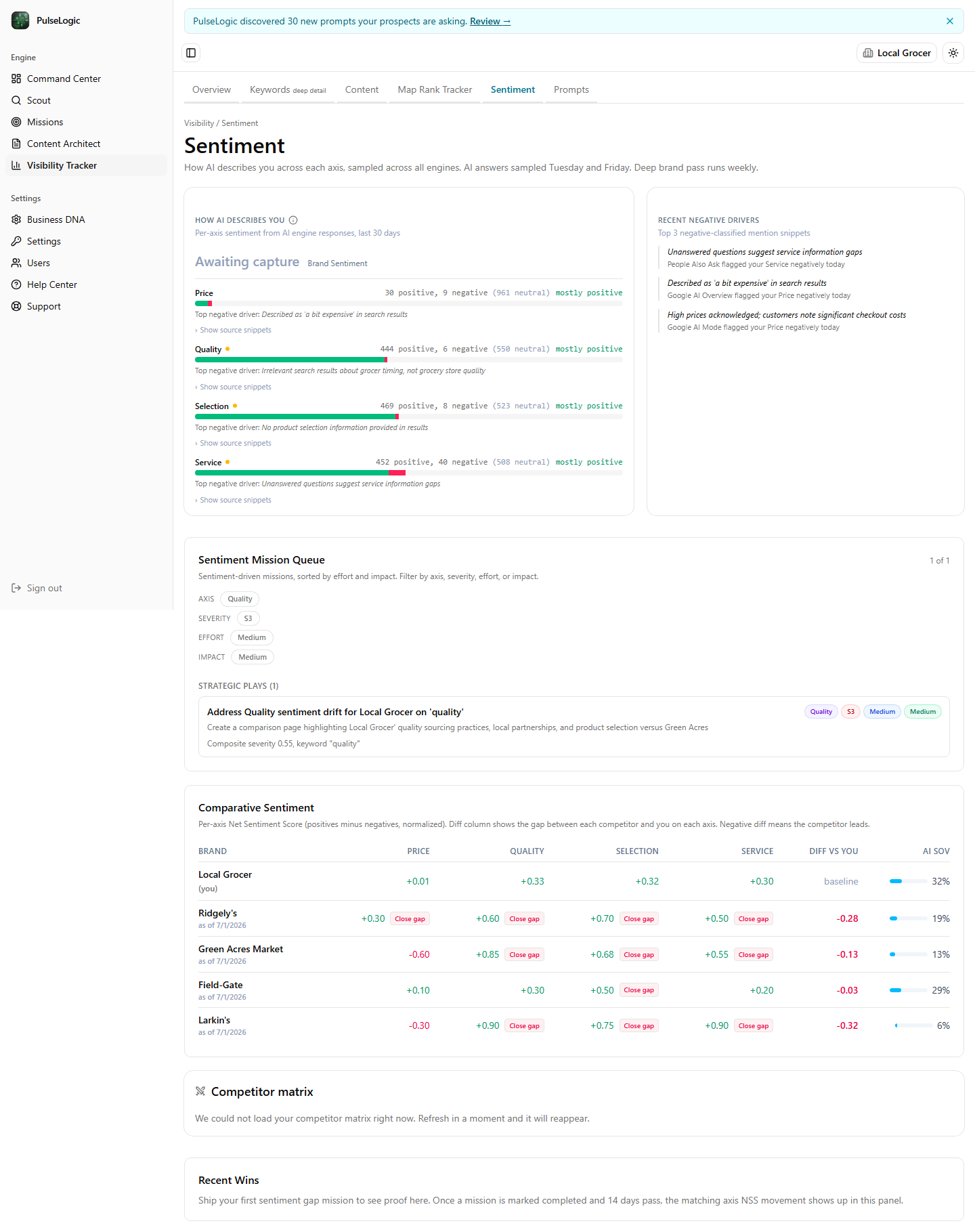
Scored on the axes your category is judged on
For a grocer the axes are price, quality, selection, and service. Each cell is a Net Sentiment Score, positives minus negatives normalized to a single scale, for that brand on that axis. Your competitors are scored on exactly the same axes, from the same answers, which is what makes the comparison mean anything.
Share of voice inside the answer
Alongside the axis scores, the grid reports how much of the AI recommendation answer each brand occupies. Being mentioned is not the same as being the recommendation, and a brand can hold a respectable sentiment score while barely appearing. Both numbers sit on the same row so the gap between them is visible.
The close gap control is the point
Where a competitor leads you on an axis by a meaningful margin, a close gap control appears in that cell. One click seeds a content mission tagged with the axis and the competitor that won it. That is the whole difference between a listening tool and this: you go from noticing that a regional chain beats you on selection to a drafted article about it in two clicks.
Badges that read like a person wrote them
An axis reads strongly positive when there are no negatives, and mostly positive or under half positive otherwise, with neutral mentions counted separately so they never dilute the verdict. Hundreds of positives and zero negatives never wear a warning badge, which sounds obvious until you have used a tool that does exactly that.
What it does not do
Worth knowing before you buy, not after.
- Sentiment is not visibility. A strong score on an axis says nothing about whether you are named in the first place.
- Competitors are the ones you name. The grid scores your declared competitor list, so it is only as useful as that list is honest.
- A threat tier reads not yet rated when there is genuinely no overlap data. It will not show a reassuring low that has nothing behind it.
Questions
What buyers ask before they start
Is sentiment the same as visibility?
No. Visibility asks whether AI names you. Sentiment asks how AI describes you when it does. A business can be named constantly and described badly, or described well and rarely named, and those are different problems with different fixes.
How are competitors chosen?
You name them. The comparative grid scores your declared competitor list on the same axes as your own brand, from the same AI answers, so the comparison is like for like.
What happens when a competitor beats us on an axis?
A close gap control appears in that cell. One click creates a content mission tagged with the axis and the competitor that won it, and the mission enters the same queue as every other opportunity.